Astronomy ABCs: F is for the Faber-Jackson Relation and the Fundamental Plane
Aaaaaaand we’re back to regular programming, which means another post in my Astronomy ABCs series. This month we are on the letter F, and what other topic could I possibly choose than the Faber-Jackson Relation and the Fundamental Plane (two “F”s for the price of one!).
The Faber-Jackson Relation
Way back in the old days of 1976, two astronomers - Sandra Faber and Robert Jackson - published a paper called “Velocity dispersions and mass-to-light ratios for elliptical galaxies.” In this paper they studied 25 elliptical and lenticular galaxies and they realized that the measured velocity dispersions correlated with the absolute magnitude (or luminosity) of the galaxy. In plot form, it looks like this:
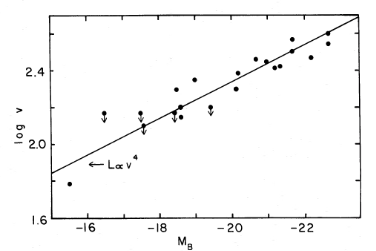
Figure 16 from the Faber & Jackson 1976 paper. Line of sight velocity dispersions are on the y-axis. Absolute magnitudes in the B band are on the x-axis.
Alas, I have used terms like “absolute magnitude” and “velocity dispersion.” I suppose I should explain what those things are before we move on.
Luminosity/Absolute Magnitude
Luminosity and absolute magnitude are related concepts, and often are used interchangeably in astronomy, so it makes sense to talk about them together.
Luminosity is can be thought of as how bright something is, while absolute magnitude is how bright something appears to be from a standard distance (in astronomy that distance is 10 pc). Luminosity is a measurement of how much energy is being released per unit time. If we’re talking about something like a light bulb, it’s luminosity would me reported in Watts. In astronomy, we talk about luminosity in terms of how it compares to the Sun (“solar luminosity).
Absolute magnitude is a measure of an object’s luminosity. It’s how bright the object would look if we were 10 pc away from it. (As far as I know, this 10 pc is arbitrary, but you have measure against something.) It’s measured on a logarithmic scale. If two objects have a difference of 5 magnitudes in brightness, that actually means that the ratio of their luminosities is 100. Also, the lower the absolute magntude is, the brighter it is. Something with a negative absolute magnitude is brighter than something with a positive absolute magnitude. It’s all a little messy, but these are both measurements of how bright something is. Not to be confused with apparent magntude, which is how bright something looks, which can vary a lot with distance and other things (think about how a light bulb looks dimmer when it’s far away compared to when it’s right next to you).
Velocity Dispersion
I think most of use have some experience with bright things. Light bulbs, the Sun, my personality…luminosity and apparent magnitude might not be the words we use every day, but the concepts are familiar. That probably is not the case with velocity dispersion.
Let’s think about a single star. It will have a spectrum that might look something like this:
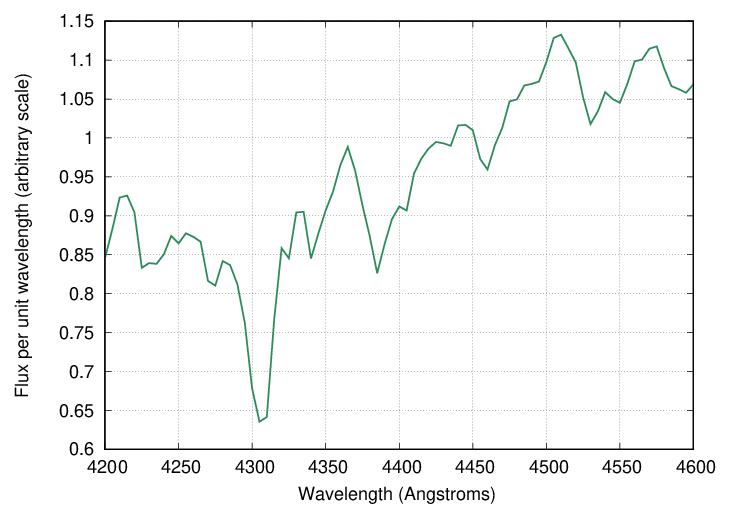
Sample stellar spectra taken from here. The y-axis is basically how much light is being detected and the x-axis is the wavelength of light. This type of graph shows how much light is coming through at each wavelength.
This is zoomed in and only shows a small range of wavelengths, but that’s fine.
This is great, but everything in the Unvierse is moving relative to us here on Earth. This causes the spectrum to undergo a Doppler shift, which will shift the spectrum to either bluer or redder wavelengths, depending on it’s velocity. If the star is moving toward us, the light will look bluer. If it’s moving away the light will look more red. Below is how the spectrum seen above would compare to those shifted values:
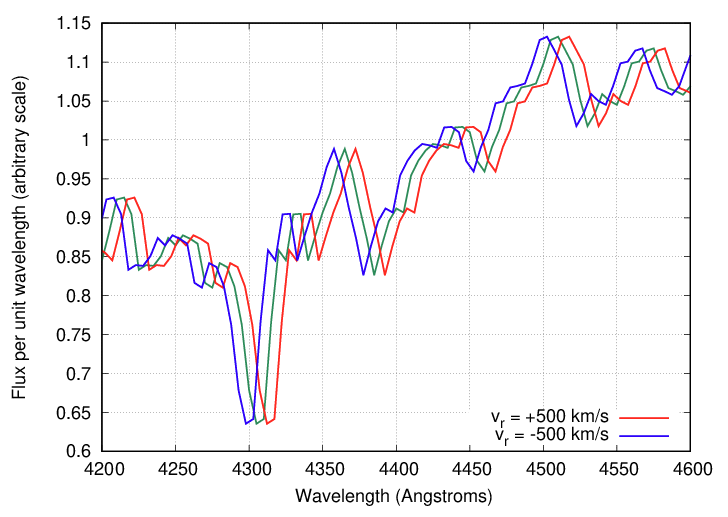
Doppler shifted spectra taken from here. Axes are the same.
The blue line represents a star moving toward us at 500 km/s, the green line is the original star that we assume is not moving relative to us at all, and the red line is a star moving away from us at 500 km/s. The amount of shift we see is very dependent on how fast the star is moving, but you can kind of see what I’m talking about. The movement shifts the spectra.
Getting spectra from an astronomical object is a wonderful thing. A spectrum is like a fingerprint. Every atom and molecule has distinct lines (those dips and peaks). They are so regular that we can name what an object is made of, just by looking at the spectral lines. If those lines are shifted from where they would be normally, we know the object is moving.
This is fine for an individual star, but how does this work with galaxies. Galaxies are combinations of millions or billions of stars. In elliptical galaxies, those stars are orbiting the center of the galaxy is random directions. Some are on a part of their orbital path that moves toward us, some are moving away. Some are only moving sideways. When we get a spectrum of a galaxy, we get a combination spectrum of all of the galaxy’s stars. Calculating the velocity dispersion of a galaxy is kind of like plotting the velocities of all the stars in it and figuring out the standard deviation of that distribution.
The Faber-Jackson Relation, revisited
What Faber and Jackson did in their 1976 paper was measure the velocity dispersions and absolute magnitudes of several elliptical galaxies and found that they correlated; that is, galaxies with larger velocity dispersions also tended to be more luminous.
What’s cool about this is that you can use it to calculate extragalactic distances. Distance measurement has always been kind of pain in astronomy. Things are so.far.away. One way we can calculate distance is through something called the distance modulus:
m - M = 5 log(d) - 5
where m is the apparent magnitude (how bright something looks), M is the absolute magnitude (how bright something is), and d is the distance you want to find. Figuring out how bright soemthing looks is easy. Figuring out how bright something is…well, that’s tougher. But with the Faber-Jackson Relation, if we can measure the velocity dispersion of a galaxy, we can make a pretty good estimation of it’s absolute magnitude, and from there all we have to do is plug and chug and we have a not-too-bad estimate for distance!
Fundamental Plane
Faber and Jackson also found a correlation between velocity dispersion and mass-to-light ratios. The mass-to-light ratio is the ratio of the total mass of a galaxy (normal matter, no dark matter) and the total energy output of the galaxy (it’s luminosity). Faber and Jackson found that the more luminous the galaxy, the higher its mass-to-light ratio. And since they also found that luminosity is positively correlated with velocity dispersion, we now know that the larger the velocity dispersion, the larger the mass-to-light ratio.
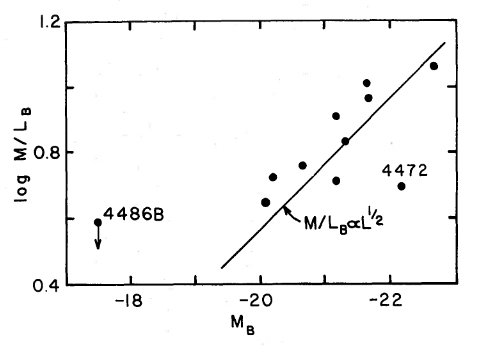
Figure 17 from the Faber & Jackson 1976 paper. Mass-to-light ratios are on the y-axis. Absolute magnitudes in the B band are on the x-axis.
A lot of characteristics of normal elliptical galaxies have shown to be correlated, including the radius of the galaxy, its surface brightness, as well as velocity dispersion. Because there are three variables instead of just two, astronomers call this the fundamental plane (apparently coined by Djorgovski & Davis 1987). Any two variables can predict the third. Amazing!
These findings are a big deal in extragalactic astronomy. It showed that normal (non-dwarf) elliptical galaxies are a class of object all their own.
Featured image credit: Elliptical Galaxy IC 2006 by ESA/Hubble